How to Choose the Right Suspension Cells for Your Research?
When choosing suspension cells for research, the decision can be daunting. Dr. Samantha Lee, a leading expert in cell biology, states, “The right suspension cells can transform your experiment's outcome.” This emphasizes the importance of making an informed choice.
Suspension cells are crucial in various studies, from drug development to cancer research. Their ability to grow in a liquid medium offers unique advantages. For researchers, knowing the specific applications of different suspension cell types is essential. Various factors must be considered. The cell source, growth conditions, and desired outcomes may vary across experiments.
It's also vital to note limitations. Some suspension cells may not provide the best model for every situation. Researchers must evaluate their project's specific needs closely. Moreover, expert guidance can help navigate these complexities, ensuring the best fit for your research goals.
Understanding the Role of Suspension Cells in Research Applications
Suspension cells play a vital role in various research applications, particularly in cell biology and drug development. These cells thrive in a culture medium, making them ideal for large-scale production. Researchers often utilize them for studying cellular behavior, drug responses, and interactions with other cell types. Their adaptability can offer unique insights into mechanistic pathways.
The choice of suspension cells depends on specific research goals. Some researchers focus on hematopoietic stem cells, while others may prioritize immune or tumor cells. Each type presents unique properties and behaviors in suspension culture. Understanding these distinctions is crucial. It can significantly influence experimental outcomes and data interpretation.
Challenges exist in working with suspension cells. They can often show variability in behavior between batches. This inconsistency can lead to reproducibility issues. Regular evaluation and optimization of culture conditions are essential for reliable data. Researchers must remain vigilant and open to refining their approaches to achieve the best results.
How to Choose the Right Suspension Cells for Your Research?
| Cell Type |
Origin |
Applications |
Growth Conditions |
Transfection Efficiency |
| HEK293 |
Human Embryonic Kidney |
Protein Production, Gene Expression |
37°C, 5% CO2 |
High |
| CHO |
Chinese Hamster Ovary |
Monoclonal Antibody Production |
37°C, 5% CO2 |
Moderate |
| Jurkat |
Human T-Cell Line |
Immunological Studies |
37°C, 5% CO2 |
High |
| K562 |
Human Chronic Myelogenous Leukemia |
Cancer Research, Drug Testing |
37°C, 5% CO2 |
Moderate |
| MCF-7 |
Human Breast Cancer |
Breast Cancer Research |
37°C, 5% CO2 |
Moderate |
Identifying the Characteristics of Ideal Suspension Cell Lines
Choosing the right suspension cells is crucial for research success. Ideal suspension cell lines exhibit specific characteristics that enhance research outcomes. These cells should have robust growth rates, enabling efficient experimentation. According to industry reports, cell lines with doubling times under 24 hours are highly preferred for various applications.
Stability is another vital characteristic. Some cell lines may lose characteristics over time due to genetic drift. Reports suggest that maintaining a consistent phenotype is crucial for reproducibility in experiments. Regular monitoring can help identify any deviations that might occur.
Researchers often overlook the importance of adaptability. Ideal cell lines should thrive in diverse conditions. This flexibility aids in various experimental settings. Balancing growth rate, stability, and adaptability can be complex. Reflecting on previous choices can help refine future selections. This ongoing assessment is vital for ensuring that your chosen cell lines meet the evolving demands of your research.
Evaluating Different Types of Suspension Cells for Specific Studies
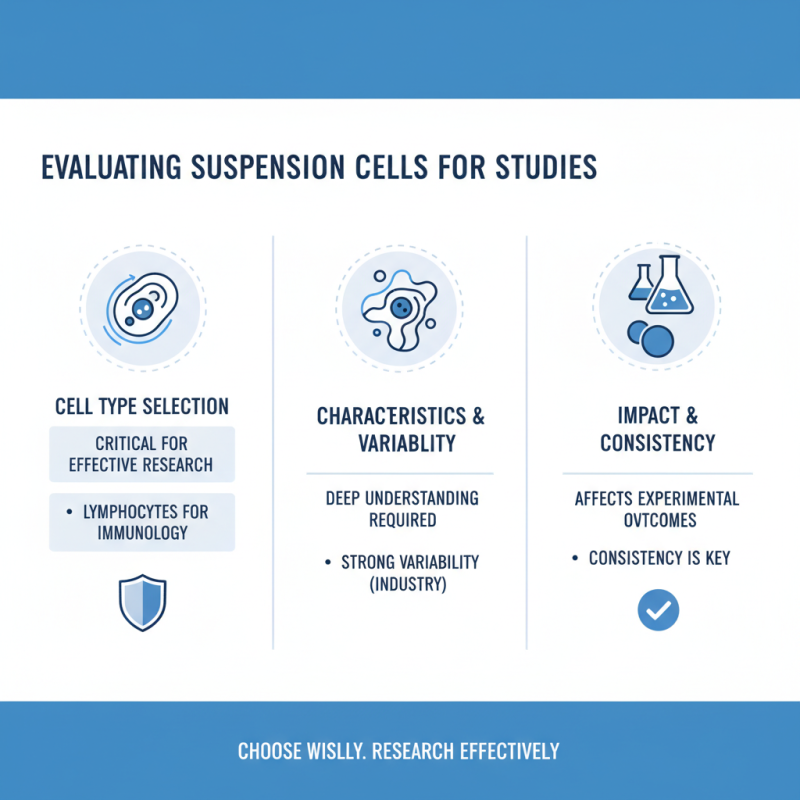
Choosing the right suspension cells is critical for effective research outcomes. Evaluating these cells requires a deep understanding of their characteristics. For instance, scientists often prefer lymphocyte cells for immunological studies due to their specific physiological responses. According to industry reports, these cells show strong variability. This variability can impact experimental consistency.
In contrast, stem cells are sought after for regenerative medicine. Their capability to differentiate into various cell types makes them ideal for diverse applications. However, stem cell cultures can be sensitive to environmental conditions. Research indicates that fluctuations in temperature or pH can lead to inconsistent results. It's important to consider these factors when selecting your cell type.
Each cell type has its strengths and weaknesses. For instance, some suspension cells proliferate quickly but may not maintain functionality over time. Others may be stable yet harder to culture. Evaluating your research needs against these qualities helps in making informed choices. Awareness of these nuances can lead to better design and implementation of your studies.
Considerations for Cell Growth Conditions and Maintenance
When selecting suspension cells for research, growth conditions play a crucial role. Optimal growth conditions directly impact cell viability and functionality. Different cell lines have unique requirements for temperature, pH, and nutrients. Researchers must understand these needs thoroughly. For instance, while some cell types thrive at 37°C, others may prefer cooler environments. This factor affects metabolic activity and growth rates.
Maintenance of cell cultures also requires attention. Regular monitoring and adjusting of cell densities are essential. Cells can become too dense, leading to nutrient depletion and waste accumulation. Researchers should consider splitting cultures timely. Additionally, the media choice is critical. Inappropriate medium can stress cells or skew experimental results.
It’s important to remember the inherent variability in cell behavior. What works for one experiment may not yield the same results in another. Differences in lot numbers for media components can introduce inconsistencies. Engaging in reflective practices can help in recognizing these potential pitfalls. Understanding the nuanced needs of suspension cells enhances the reliability of research findings.
Assessing the Availability and Cost of Suspension Cells for Research
When selecting suspension cells for research, it's crucial to consider both availability and cost. Recent studies show that approximately 30% of research institutions report difficulties in sourcing specific cell lines. This scarcity can delay projects and inflate budgets. For instance, primary suspension cells often have higher costs associated with their maintenance and procurement, sometimes reaching up to $500 per vial. Researchers must weigh these factors carefully.
Moreover, the shift towards personalized medicine and cell therapies has increased demand for unique cell types. Reports from industry experts indicate that the market for suspension cells is expected to grow at a compound annual growth rate (CAGR) of 8% over the next five years. This expansion can lead to fluctuations in pricing. Researchers must stay informed about market trends to avoid overspending. Many institutions now focus on strategic partnerships with suppliers to enhance accessibility while managing costs effectively.
Investigation into the overall cost structure is vital. Factors such as storage, transportation, and culture media can add hidden costs to the initial purchase price. Noting that nearly 40% of researchers express frustration over unexpected expenses highlights the need for thorough budgeting. Balancing quality and financial constraints requires ongoing evaluation. Researchers should continually assess their options to ensure sustainable practices in their work.
Availability and Cost of Common Suspension Cell Lines for Research